The Live Event Is a Business Laboratory
Jul 23, 2026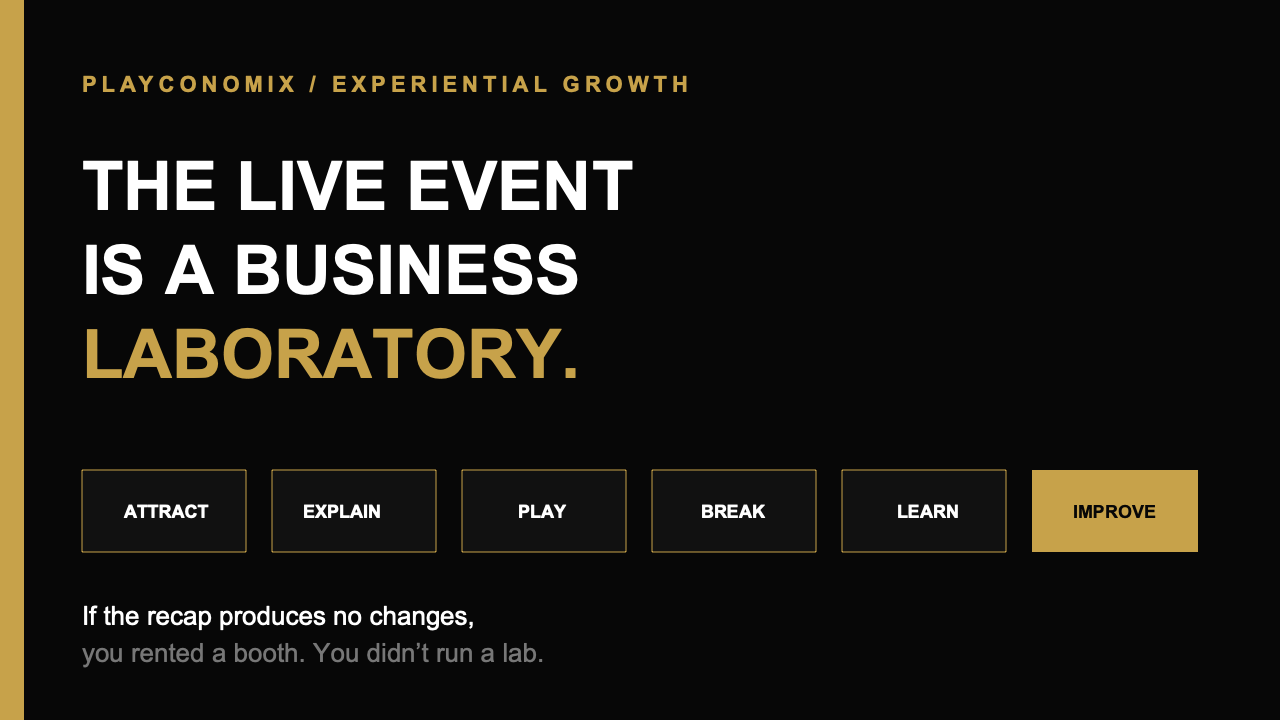
Most brands treat events like expensive photo opportunities. Build booth. Hand out swag. Scan badges. Post a recap claiming the energy was “incredible.” Fly home with sore feet and no idea what the business learned.
That is a waste.
A live event can be the fastest business laboratory you have. In one weekend, you can test the product, the pitch, the price, the rules, the durability, the audience, the content, and the community. Real people will show you what works—usually with less politeness than your internal meetings.
People tell the truth with their feet
Surveys are useful. Behavior is better.
At an event, you see whether people stop. Whether they understand the product without a speech. Whether strangers are willing to try it. Whether they invite a friend. Whether spectators become participants. Whether somebody asks where to buy it before your staff starts selling.
That is signal.
Design the experiment before designing the booth
Pick three questions you want the event to answer. Not thirty. Three.
- Can a new player understand the rules in under two minutes?
- Which challenge creates the longest line?
- Does the premium package convert at the expected rate?
- Which component fails under repeated public use?
- What phrase do customers use when explaining the product to friends?
Then build the activation around observing those questions.
Breakage is data
Founders hate seeing products fail in public. I get it. But a product that survives a conference room and breaks after two hundred enthusiastic strangers use it has given you valuable information.
Watch how people misuse it. Watch what instructions they ignore. Watch what gets stepped on, pulled, twisted, lost, or assembled backward.
Customers do not use products according to your PowerPoint. Design for reality.
The best content is already happening
Do not force your team to manufacture thirty fake social clips next week. Capture the real reactions, debates, misses, wins, teaching moments, and ridiculous failures happening now.
A great event produces:
- Customer demonstrations.
- Frequently asked questions.
- Product tutorials.
- Competitive challenges.
- Testimonials with actual emotion.
- Design debates people want to join.
One good activation should feed the content calendar for weeks.
Close the learning loop on Monday
Events become theater when the lessons die in a recap deck.
Within 48 hours, document:
- What surprised us?
- What broke?
- What language did customers use?
- What generated participation?
- What created demand?
- What will we change before the next event?
Assign owners. Set dates. Change the product, pitch, setup, or follow-up. Otherwise you did not run a laboratory. You rented a booth.
The Playconomix takeaway
Live events compress months of assumptions into hours of observable behavior. They can build community and produce revenue, but their highest value may be speed of learning.
Do not ask whether the event “went well.” Ask what the business knows now that it did not know before.
Want to build events that create participation, insight, and demand? Connect with Playconomix.
CONSUMER BRAND BUILDER SOCIETY
Keep building inside the right level of support.
Basic brings the workshops, recordings, and peer community. Standard adds monthly private decision support and the full operating library. VIP adds weekly priority support and execution accountability.
One Society. Three ways to get the support the work requires.
GET THE PLAYMAKER'S PULSE
Sharp, practical field notes on leadership, operations, product, community, and building companies that can handle their next stage.
No spam. No recycled motivational fluff. Unsubscribe anytime.