Stop Managing Activity. Start Managing Finished Work.
Jul 23, 2026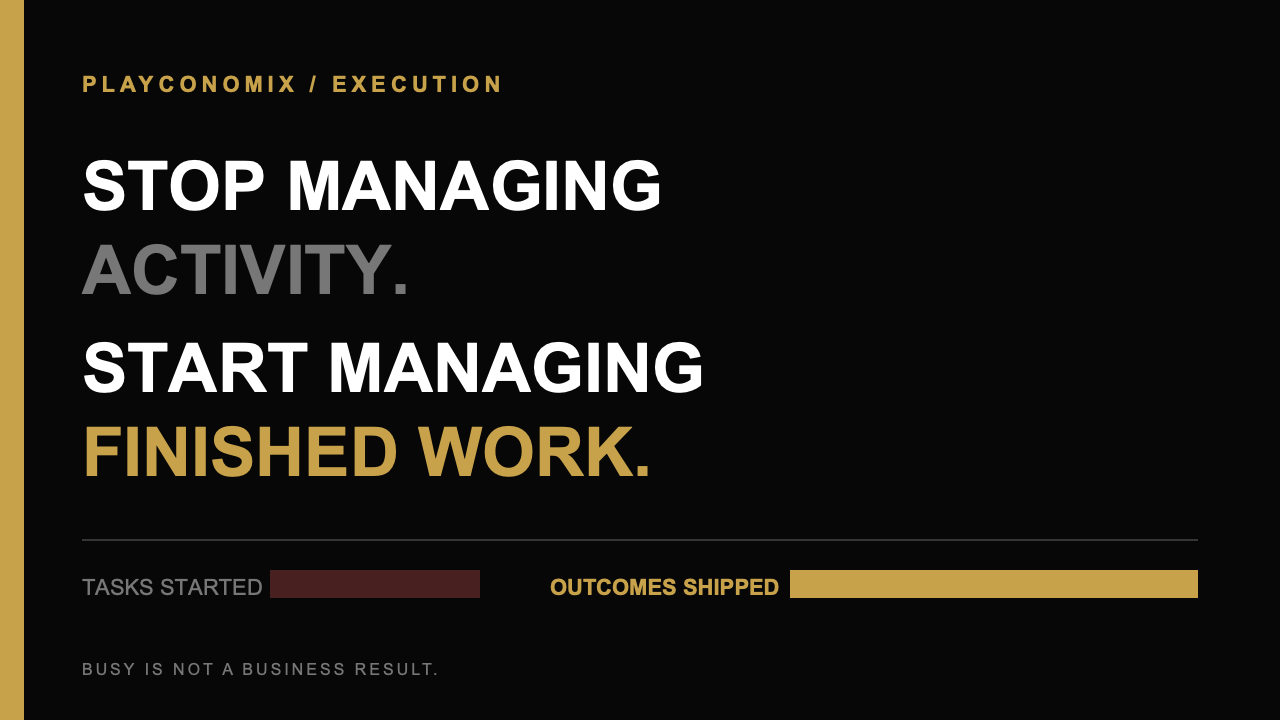
Busy is not a business result. Slack messages are not a business result. Meetings are not a business result. Ninety percent complete is definitely not a business result.
I have seen teams work their asses off all week and still finish Friday with nothing usable. No shipment closed. No decision made. No process stabilized. No customer fully recovered. Just a pile of motion and a calendar that looks like it lost a bar fight.
The problem is usually not laziness. It is work designed around activity instead of finished goods.
Partial progress creates organizational debt
Imagine a warehouse team opens fifty boxes, removes fifty defective parts, and stops. Technically, they did a lot. Operationally, they now have fifty unusable products covering the floor.
The better unit of work is smaller but complete: open one box, repair the product, verify it, close the box, return it to sellable inventory. Repeat.
One approach creates impressive activity. The other creates finished goods.
Meetings held
Messages sent
Tasks started
Hours worked
Orders shipped
Decisions closed
Customers recovered
Systems stabilized
Ten priorities means zero priorities
Growing companies love starting things. Every customer complaint becomes a project. Every idea becomes an initiative. Every meeting produces another list.
Then the same issues keep resurfacing because nobody stayed with one long enough to kill it.
I would rather have a team finish three meaningful things this week than “make progress” on twenty. Progress is useful only when it compounds toward closure. Otherwise it is expensive context switching.
Define done before the work starts
Most projects drift because “done” was never defined. Try this:
- Outcome: What is different when this is complete?
- Evidence: What proves it works?
- Owner: Who closes the loop?
- Receiver: Who uses or approves the output?
- Deadline: When does delay begin costing us?
“Improve fulfillment” is not a finished-work definition. “All orders older than 48 hours are assigned, exceptions are documented, and a daily owner reviews the queue” is.
Make work travel in smaller completed batches
Big batches hide problems. Smaller completed batches create faster feedback and protect the business from half-done chaos.
This applies everywhere:
- Repair one product completely instead of disassembling a hundred.
- Write, approve, and publish one campaign instead of outlining ten.
- Fix one automation from trigger to verified output instead of connecting six unreliable tools.
- Resolve one customer issue end-to-end instead of touching twenty tickets.
Leaders must stop rewarding visible struggle
Some organizations accidentally celebrate the person surrounded by emergencies. They are online late. They are in every conversation. They always look slammed.
Meanwhile, the quiet operator built a process that prevented the emergency and went home at five.
Reward the second person.
Heroics feel exciting, but reliable systems are what make a business valuable.
The Playconomix takeaway
Every business is a game with limited time, people, cash, and attention. If your scoring system rewards motion, you will get motion. If it rewards closed loops and usable outputs, you will get finished work.
Stop asking, “What did everybody work on?” Ask, “What can the business use now that it could not use Monday?”
CONSUMER BRAND BUILDER SOCIETY
Keep building inside the right level of support.
Basic brings the workshops, recordings, and peer community. Standard adds monthly private decision support and the full operating library. VIP adds weekly priority support and execution accountability.
One Society. Three ways to get the support the work requires.
GET THE PLAYMAKER'S PULSE
Sharp, practical field notes on leadership, operations, product, community, and building companies that can handle their next stage.
No spam. No recycled motivational fluff. Unsubscribe anytime.