Print Is Custom Manufacturing—and It Built the Operator I Became
Jul 23, 2026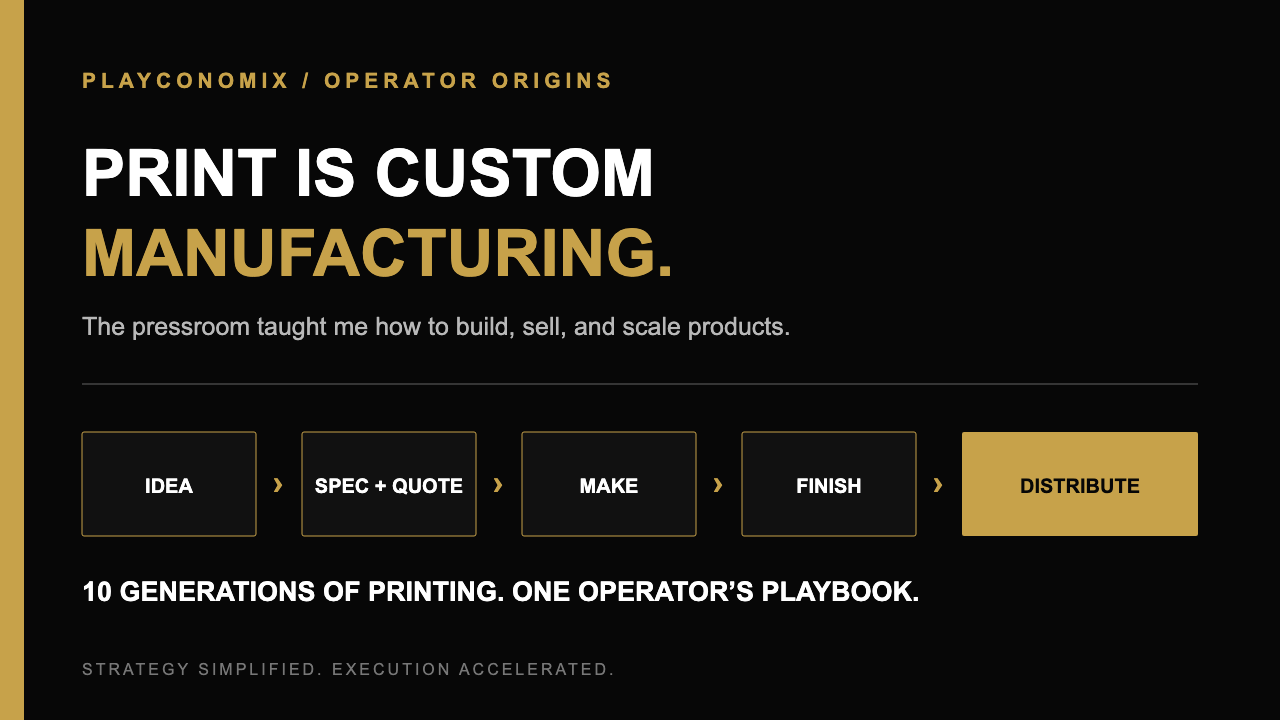
Most people think I left printing and moved into consumer products.
I don’t see it that way.
I took the operating system the print industry beat into me—the estimating, materials, equipment constraints, custom production, finishing, deadlines, fulfillment, and daily parade of things that can go sideways—and applied it to building a global consumer brand.
Printing did not sit before my career as an operator. Printing built the operator.
Print is custom manufacturing. Full stop.
The industry undersells itself when it talks only about ink on paper. A commercial printer is running a custom-manufacturing company with a marketing-services layer and, often, a logistics business bolted to the back.
You start with an idea that is usually incomplete. You turn it into a specification. You quote it before every production variable is perfectly known. You source consumables such as paper and ink. You select equipment—litho, digital, or some combination—based on quantity, quality, format, timing, and economics. You manufacture the piece. You finish it. You package it. Then you distribute it to a customer, a store, or thousands of individual mailboxes on behalf of a brand.
That is not “just printing.” That is the complete product lifecycle.
In printing, even salespeople are operators
That statement may irritate a few people. Good.
In many industries, sales can toss an order over the wall and move on. In printing, the best salespeople cannot survive that way. They get pulled into estimating, substrates, press capabilities, color requirements, finishing options, schedules, postage, freight, and delivery.
They need to know what the customer wants, what the equipment can actually do, what the job will cost, what can fail, and whether the promise can still be kept profitably.
Sometimes a customer wants something custom that nobody knows for certain will work. Sometimes you sell it anyway. Then everybody gets very smart, very quickly.
Some inks do not behave on certain stocks. Some paper runs beautifully on one machine and creates a nightmare on another. A finishing step that looks harmless can become the bottleneck. A mailing date does not care that a vendor missed a delivery. And the job that looked profitable in the estimate can bleed margin through waste, reruns, overtime, and freight.
What can go wrong will go wrong. The job is to make most of it go wrong in your head before it goes wrong on the floor.
That is operations.
I am a 10th-generation printer
My family’s connection to printing reaches back ten generations, all the way to the days of typesetting. I spent roughly a decade in the industry myself, coming up through marketing and print services before moving to the brand side.
The family stories were never only about presses. They were about invention.
My dad was one of the originators of the “Pro Card,” the inline faux credit card placed inside direct-mail pieces. The company also developed and patented equipment that could fold maps inline directly off the press. That efficiency created a cost advantage competitors could not easily touch and helped the business produce Disney park maps for years.
That is the lesson worth paying attention to: the real advantage was not owning a press. It was redesigning the process around the outcome.
The equipment became intellectual property. The workflow became a moat. The finished piece became a repeatable product instead of another commodity print job.
The jump from print to consumer products was smaller than it looked
When I moved from printing and marketing services into games and sporting goods, the products changed. The operating questions did not.
| Consumer Products | Same Operating Question | |
|---|---|---|
| Paper and ink | Fabric, plastic, packaging | Will the materials perform? |
| Press and finishing constraints | Factory and tooling constraints | Can we manufacture the promise? |
| Makeready, spoilage, reruns | Setup, scrap, defects | Where is margin leaking? |
| Direct mail and freight | DTC, retail, and global distribution | How does it reach the buyer? |
| Custom job specifications | Product requirements | What exactly are we building? |
That foundation helped me become Spikeball’s first employee and later its COO. I helped build the operating infrastructure behind growth from roughly $500,000 to nearly $50 million in revenue, expand a brand and sport into more than 70 countries, negotiate with factories, develop products, build supply chains, manage inventory and cash pressure, support a distributed team, and help a community-driven product reach millions of players.
Those are consumer-product accomplishments. But the instincts behind them were forged in print:
- Get painfully clear about the specification.
- Understand the equipment and supplier constraints before making the promise.
- Build quality into the process instead of inspecting for it at the end.
- Know the real cost, including waste and exceptions.
- Design fulfillment at the same time you design the product.
- Never confuse a full schedule with a profitable business.
Printing companies are sitting on more opportunity than they think
The print industry has real problems. Margins are thin. Too many companies compete on price. Estimating knowledge lives inside a few experienced heads. Sales pipelines are inconsistent. Handoffs are messy. Legacy systems do not talk to each other. Every job feels custom, and every exception seems to require a meeting.
But “that’s just printing” is not a strategy.
Printers should be asking some bigger questions:
- Which custom services can be turned into clearly defined, repeatable products?
- Where can automation and AI remove administrative work without weakening craftsmanship?
- Which quoting, proofing, scheduling, and follow-up workflows should stop living in email?
- What proprietary equipment, finishing method, data workflow, or distribution capability could become a competitive moat?
- What consumer products could the company build and own instead of only manufacturing for somebody else?
- How can salespeople spend more time selling and less time hunting for job status?
A printing company already has many of the pieces required to become a product company: equipment, production knowledge, vendor relationships, design capability, finishing, packaging, fulfillment, and customers with real problems.
The opportunity is to connect those pieces differently.
The future of print is not less operational. It is more intentional.
I still love the power of print. A physical piece can create attention, emotion, trust, and action in ways another disposable digital impression cannot. Direct mail can put a brand into somebody’s hands. Packaging can change the perceived value of a product. A smart printed tool can become part of the product itself.
But love for the craft cannot become an excuse for weak systems, commodity positioning, or permanently bad margins.
Printers do not need another outsider to tell them to “go digital.” They need operators who respect what happens on the floor, understand custom manufacturing, and can bring better systems, stronger offers, smarter workflows, modern lead generation, AI-enabled execution, and product thinking into the business without stripping away what makes the company valuable.
I understand that world because I came from it.
And I understand the other side because I used those lessons to help build a fast-growing global consumer brand.
Printing and consumer products are not distant cousins. They are running the same operating playbook with different materials.
CONSUMER BRAND BUILDER SOCIETY
Keep building inside the right level of support.
Basic brings the workshops, recordings, and peer community. Standard adds monthly private decision support and the full operating library. VIP adds weekly priority support and execution accountability.
One Society. Three ways to get the support the work requires.
GET THE PLAYMAKER'S PULSE
Sharp, practical field notes on leadership, operations, product, community, and building companies that can handle their next stage.
No spam. No recycled motivational fluff. Unsubscribe anytime.