Don’t Automate a Process You Can’t Explain
Jul 23, 2026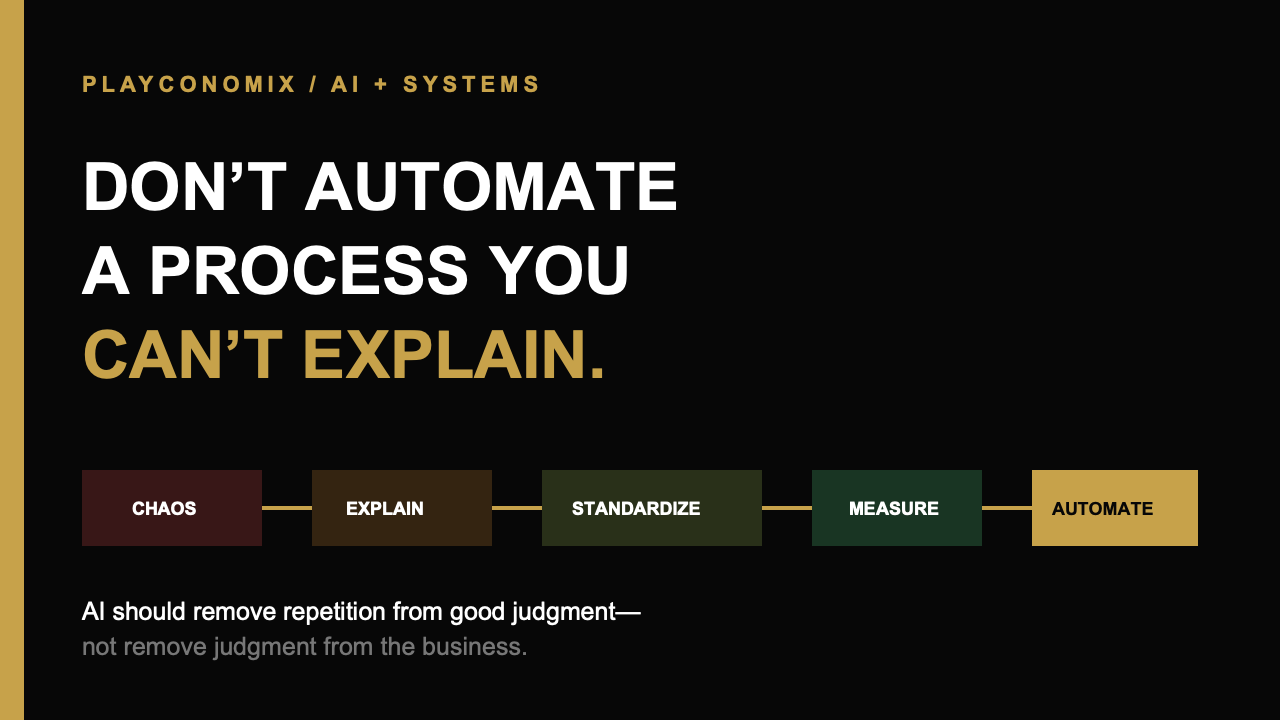
AI can do some incredible shit. It can also help you execute a terrible process faster, at greater scale, with fewer humans noticing until the customer is furious.
Founders keep asking, “Can we automate this?” My first question is usually, “Can anybody explain this?”
If the answer is a twelve-minute story involving three spreadsheets, a Slack search, tribal knowledge, and “then Jenny usually knows what to do,” you do not have an automation opportunity yet. You have an operating-model problem.
Automation multiplies the process you give it
A clean process becomes faster. A confused process becomes industrial-grade confusion.
Technology does not remove ambiguity. It forces ambiguity to make decisions. When the rules are unclear, the system will guess, fail, or dump exceptions back on humans—usually after creating a bigger mess.
Start with the normal path
Before building an agent, integration, or automation, write down what happens in the normal case:
- What triggers the work?
- What information is required?
- What decision gets made?
- What action follows?
- What proves it worked?
- Who owns the exception?
If the team cannot agree on those six answers, adding software is just installing fog lights on a car with no steering wheel.
The exception is the real product
Most demos look great because they show the happy path. Real businesses live in exceptions: missing addresses, mismatched SKUs, partial inventory, duplicate customers, late retailer windows, weird payment terms, damaged products, and somebody typing a state abbreviation into the country field.
Good automation does not pretend exceptions disappear. It identifies them early, explains why they stopped, and routes them to the right human with the relevant context.
The goal is not “zero humans.” The goal is zero wasted human attention.
Use AI where judgment is repeatable
AI is excellent when it has a clear operating envelope:
- Classify an incoming request.
- Gather information from known systems.
- Draft a response using approved rules.
- Flag missing or contradictory data.
- Prepare a transaction for human approval.
- Monitor whether an expected event happened.
It becomes dangerous when leaders confuse fluent output with accountable judgment.
Build the scoreboard before the robot
Before automating, decide what success looks like. Cycle time? Accuracy? Cost per transaction? Exceptions per hundred orders? Customer recontacts? Manual touches?
If you cannot measure the current process, you will not know whether the automation improved it or simply made it harder to inspect.
The Playconomix takeaway
Automation should be the final step in understanding work, not the first step in avoiding it.
Explain the process. Simplify it. Standardize the normal path. Define the exceptions. Create the scoreboard. Then automate the boring parts aggressively.
AI should remove repetition from good judgment—not remove judgment from the business.
CONSUMER BRAND BUILDER SOCIETY
Keep building inside the right level of support.
Basic brings the workshops, recordings, and peer community. Standard adds monthly private decision support and the full operating library. VIP adds weekly priority support and execution accountability.
One Society. Three ways to get the support the work requires.
GET THE PLAYMAKER'S PULSE
Sharp, practical field notes on leadership, operations, product, community, and building companies that can handle their next stage.
No spam. No recycled motivational fluff. Unsubscribe anytime.