Culture Is Not the Absence of Accountability
Jul 23, 2026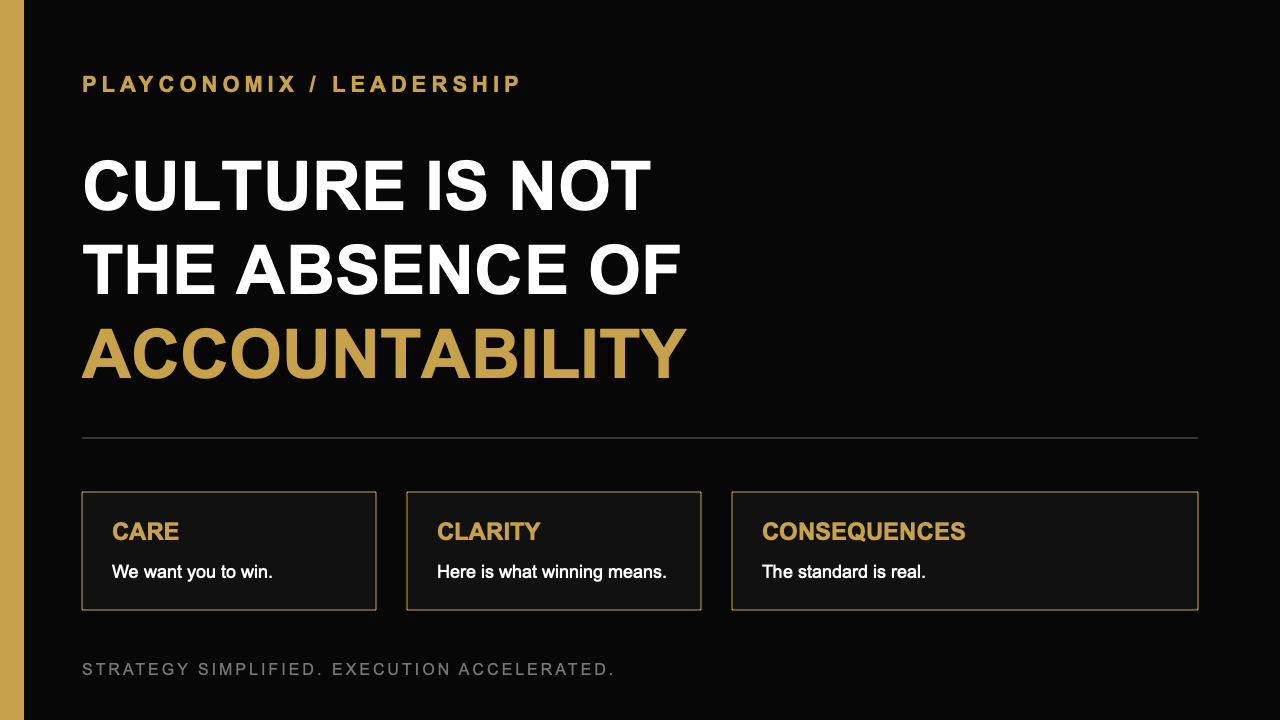
Let’s kill one of the dumbest ideas in modern business: holding people accountable does not ruin culture. Avoiding hard conversations ruins culture.
I’ve watched good companies tie themselves into knots because the leaders wanted to be “people first.” That sounds noble. But somewhere along the way, people first became standards last. Deadlines became suggestions. Repeated mistakes became “learning opportunities.” Nobody wanted to be the bad guy, so the dependable people quietly became the cleanup crew.
That is not culture. That is organizational cowardice wearing a company hoodie.
Your best people already know who is not carrying the weight
Leaders sometimes act as if performance problems are private. They aren’t. The team sees the missed calls, unfinished projects, ignored instructions, and problems that keep boomeranging back. Your strongest employees are watching what leadership tolerates.
Every time you avoid an obvious issue, you send two messages:
- To the person missing the standard: this is apparently acceptable.
- To the person carrying extra weight: your effort is apparently free.
That second message is how good people burn out.
We want you to win.
Here is what winning means.
The standard is real.
Accountability without clarity is just ambush management
Before you decide somebody is failing, ask whether the company has done its job. Is the outcome clear? Is there one owner? Is the deadline real? Does the person have authority and resources? Do they know how performance is measured?
If not, fix the system before you blame the person.
But once the expectations are clear, stop moving the goalposts to avoid discomfort. A standard that produces no response when it is missed is not a standard. It is wall art.
Use the three-conversation rule
Conversation one: Align
“Here is the outcome. Here is why it matters. Tell me how you understand your responsibility.” Do not confuse agreement with understanding. Have them play it back.
Conversation two: Diagnose
“We missed it. Was the problem skill, capacity, judgment, priority, or follow-through?” This is where leaders coach, remove obstacles, and correct weak processes.
Conversation three: Decide
“This pattern is continuing. Is this still the right role, structure, or person?” By this point, another vague pep talk is not kindness. It is delay.
Protect people. Don’t protect patterns.
Everybody has a bad week. People get sick. Families need attention. Systems break. Great leaders leave room for humanity.
What they do not do is pretend a six-month pattern is a bad week.
The goal is not to build a ruthless company. The goal is to build an honest one. People should know where they stand, what the team needs, and whether the role fits. That is more respectful than smiling through months of frustration and then surprising somebody with a termination.
The Playconomix takeaway
A strong culture is not comfortable all the time. Neither is a great team, a great marriage, or anything else built on trust. Strong cultures can handle the truth.
Care about people enough to set a clear bar. Coach them toward it. Give them the tools to clear it. Then have the guts to respond when the same pattern keeps winning.
Culture is not what you say about your people. Culture is what your people watch you tolerate.
CONSUMER BRAND BUILDER SOCIETY
Keep building inside the right level of support.
Basic brings the workshops, recordings, and peer community. Standard adds monthly private decision support and the full operating library. VIP adds weekly priority support and execution accountability.
One Society. Three ways to get the support the work requires.
GET THE PLAYMAKER'S PULSE
Sharp, practical field notes on leadership, operations, product, community, and building companies that can handle their next stage.
No spam. No recycled motivational fluff. Unsubscribe anytime.