Community Is Something People Do Together
Jul 23, 2026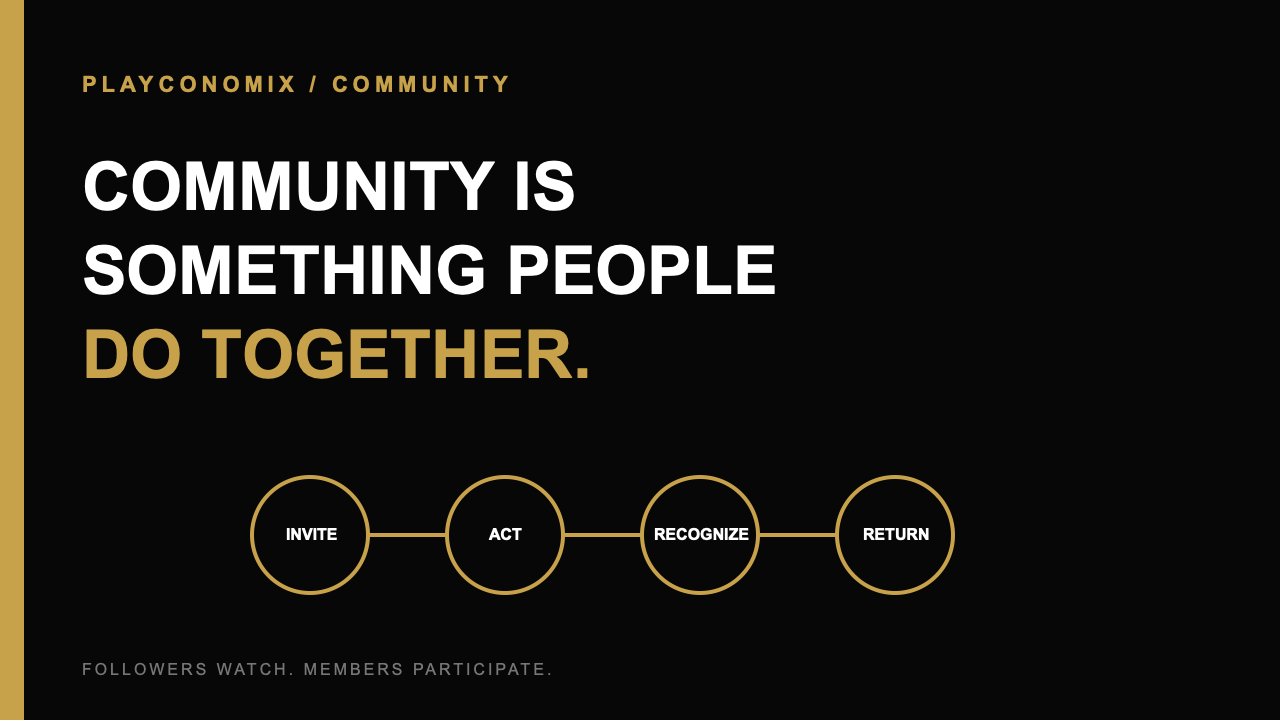
A mailing list is not a community. Followers are not a community. A Discord full of people ignoring your announcements is not a community.
Community exists when people do something together—and would notice if the other people stopped showing up.
Brands love the word because it sounds warmer than “audience.” But changing the label does not change the relationship. If the company talks and everybody else watches, you built media. That can be valuable. It just is not community.
Belonging requires participation
The best communities have a game loop. Not necessarily a literal game, although I happen to love those. People enter, take an action, receive feedback, gain status or connection, and find a reason to return.
That loop might be playing a weekly match, sharing a build, attending a local event, teaching a newcomer, submitting a product idea, or celebrating a member win.
INVITATION
Make entry easy
ACTION
Give people a role
RECOGNITION
Make contribution visible
RETURN
Create the next moment
Give people a role, not just content
“Follow us for updates” is a weak invitation. Try something people can actually do:
- Host the first game in their town.
- Teach three new players.
- Vote on a product decision.
- Submit a challenge or trick shot.
- Lead a local meetup.
- Test a prototype and report what broke.
Roles create ownership. Ownership creates stories. Stories recruit the next person better than polished brand copy ever will.
Design for the first five minutes
Most communities obsess over keeping power users engaged and ignore the awkward new person standing near the edge.
The first experience should answer three questions immediately:
- What do people do here?
- What can I do right now?
- Will anybody notice?
Games are powerful community engines because they answer those questions quickly. The rules create a shared language. The action removes small talk. The score gives strangers something to react to. Within minutes, people have a story together.
Ritual beats reach
A thousand passive followers are less valuable than fifty people who show up every Thursday.
Rituals turn an occasional interaction into identity: the weekly challenge, the annual tournament, the new-member introduction, the ridiculous trophy, the phrase everybody knows, the photo after every event.
Marketers chase impressions. Community builders create things worth repeating.
Do not manufacture authenticity
People can smell a corporate “community activation” from across the parking lot.
Your job is not to script every interaction. It is to design the conditions: a clear invitation, a reason to participate, a little friction, visible recognition, and enough room for members to make it theirs.
The strongest sign of a healthy community is that it creates things the brand did not plan.
The Playconomix takeaway
Community is not an audience with a nicer name. It is a network of people creating value for one another through repeated participation.
Stop asking, “How do we get more engagement?” Ask, “What can people do together that is worth coming back for?”
Building a sports, games, fitness, or recreation brand around real participation? Talk with Playconomix about designing the community loop.
CONSUMER BRAND BUILDER SOCIETY
Keep building inside the right level of support.
Basic brings the workshops, recordings, and peer community. Standard adds monthly private decision support and the full operating library. VIP adds weekly priority support and execution accountability.
One Society. Three ways to get the support the work requires.
GET THE PLAYMAKER'S PULSE
Sharp, practical field notes on leadership, operations, product, community, and building companies that can handle their next stage.
No spam. No recycled motivational fluff. Unsubscribe anytime.